Introduction
The Indian eCommerce market is advancing rapidly, and the brands that win are the ones that understand not just what customers buy, but why they buy it and how frequently specific product patterns shift. With millions of active listings, constant pricing changes, and fierce competition, businesses require deeper visibility into performance metrics to avoid revenue gaps. This is where Flipkart India Data Extraction becomes a powerful advantage, enabling brands to decode essential behavior indicators and identify critical performance signals.
Understanding product performance across categories, variations, ratings, discount changes, and competitor strategies allows brands to reshape their decision frameworks. For example, many businesses often struggle to identify the exact point where a product begins losing visibility or when a competitor modifies pricing by slight margins.
The Indian ecommerce landscape shows that more than 37% of brands improve their pricing, visibility, and review-based conversions with structured data models. Using intelligent pipelines connected to accurate datasets helps create a measurable view of consumer engagement.
Deep Insights Behind Marketplace Performance Patterns

Understanding marketplace performance requires analyzing far more than surface-level product indicators. Brands often make decisions based only on visible trends, missing out on the deeper patterns that guide true performance. By using Flipkart Data Scraping, businesses can measure price shifts, category movements, visibility gaps, and demand variations.
With structured analysis supported by Flipkart Product Data Scraping, brands can detect shifting variant preferences and understand how small detail adjustments generate measurable results. Attributes like size, style, and color frequently create a surprising 29% influence on category-specific conversion performance. These insights often come from processes like Flipkart Reviews Scraping, which helps categorize sentiment patterns and identify repeated buyer concerns.
Visibility modeling also becomes stronger when supported through Flipkart Product Analytics, offering key indicators such as keyword trends, impression changes, and search placement movement. Combined with automated pipelines delivered via Flipkart Product Data API and structured intelligence from Extract Flipkart Product Information, brands gain meaningful clarity into marketplace shifts.
Performance Patterns Identified Through Analysis:
| Insight Type | Example Observation | Impact on Business |
|---|---|---|
| Micro Price Shift | 1–3% competitor adjustment | Conversion fluctuates by 9–11% |
| Sentiment Movement | Repeated low-star issues | Decline in product trust |
| Variant Demand | Specific size trend rising | Inventory realignment required |
| Keyword Behavior | New search terms emerging | Visibility shifts rapidly |
With these datasets, brands can better understand early performance signals and respond quickly for optimized product momentum.
Tracking Category Competition Through Pricing Intelligence Shifts

Competitive pricing continues to be one of the strongest forces influencing product results across categories. Brands that lack visibility into competitor strategies often fail to understand ranking fluctuations or unexpected conversion drops. Using structured insights from Flipkart Pricing Data Extraction, businesses can review how pricing patterns evolve across days, weeks, or seasonal cycles.
Monitoring pricing moves also becomes stronger when supported by Flipkart Competitor Price Monitoring, which identifies undercut patterns, discounting cycles, promotional timing, and bundled offers. Processes like Flipkart Product Catalog Scraping uncover competitor upgrades in titles, descriptions, variant additions, and image refinements, all of which boost search visibility.
Brands aiming to refine performance also benefit from structured datasets gathered through Extract Flipkart Product Information, offering clarity into product attributes, demand clustering, and specification relevance. This insight helps determine which category leaders are shaping customer preference. Integration pipelines built using Flipkart Product Data API also ensure consistent delivery of real-time product metrics.
Key Insights From Competitive Intelligence:
| Data Element | Observation | Competitive Value |
|---|---|---|
| Hourly Price Change | 4% instant reduction | Better search ranking |
| Discount Cycle | Weekend-driven promotions | Higher engagement |
| Variant Addition | New size introduced | Customer shift |
| Listing Enhancement | Keywords updated | Visibility increase |
With a more complete competitive picture, brands can form pricing strategies that ensure stability while maintaining consistent ranking performance.
Predictive Analysis for Advanced Marketplace Forecasting
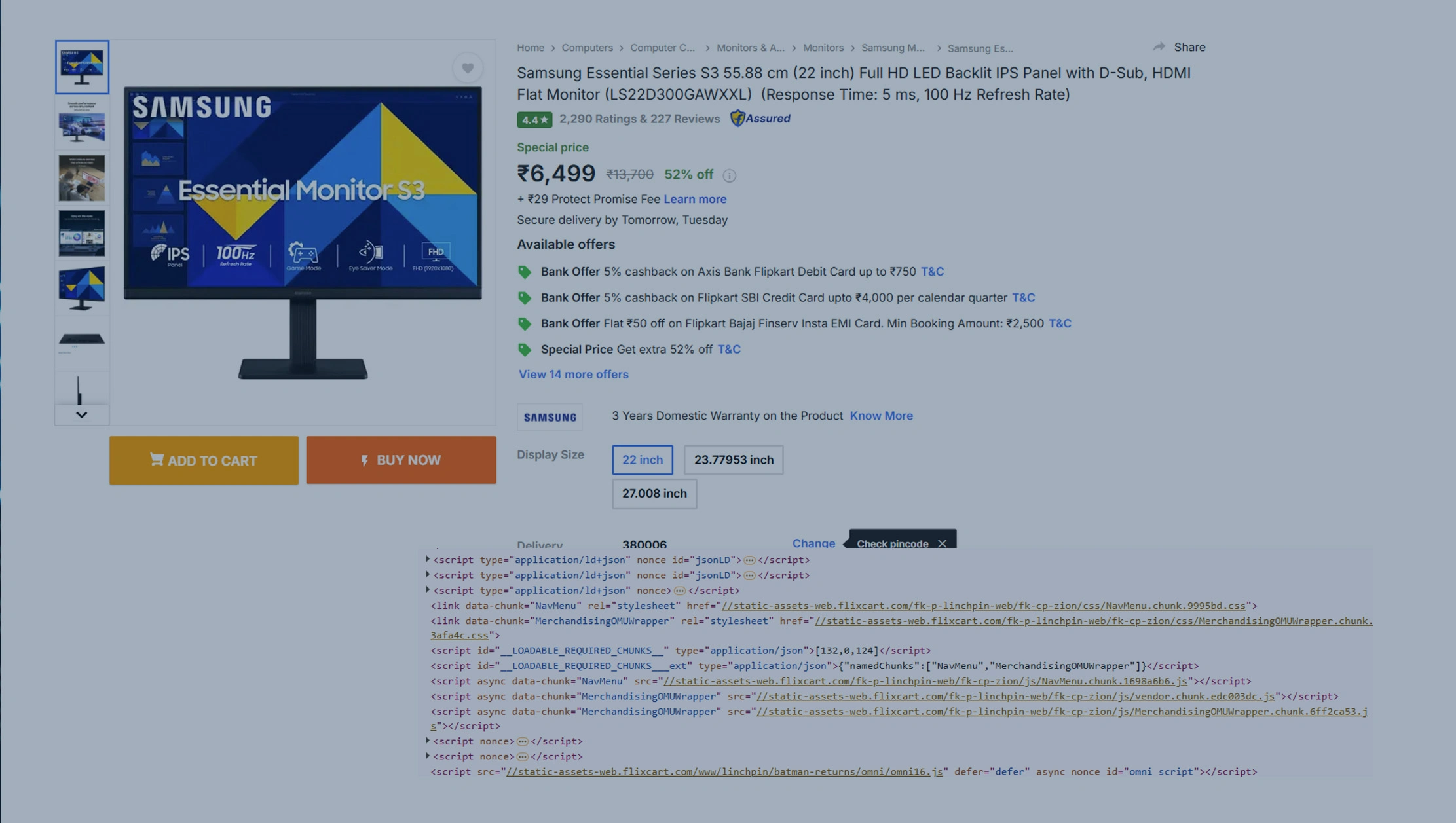
Forecasting requires more than historical performance; it depends on identifying early signals that shape future marketplace behavior. Many forecasting systems overlook dynamic changes such as sentiment shifts or competitor adjustments. Using structured intelligence supported through Flipkart Data Extraction Services, brands can build predictive frameworks that evaluate upcoming demand changes, visibility movements, and pricing sensitivities across categories.
A major forecasting driver comes from understanding review velocity and sentiment behavior. With processes like Flipkart Reviews Scraping, businesses can detect how quickly customer reactions shift across time. This data highlights when a product may face risk due to repeated complaints or reduced satisfaction.
Predictive models often perform best when powered by integrated data streams from Flipkart Product Data API, providing immediate updates on product attributes, pricing cycles, and marketplace fluctuations. At the same time, visibility and interaction trends derived from Flipkart Product Analytics help determine which listings are gaining or losing traction.
Indicators Used for Predictive Modeling:
| Predictive Factor | Observed Signal | Forecasted Outcome |
|---|---|---|
| Sentiment Change | Drop in positive reviews | Declining visibility |
| Pricing Pressure | Competitor undercuts 2% | Conversion dip |
| Variant Trend | New style gaining interest | Stock shift needed |
| Review Velocity | Faster feedback cycle | Demand increase |
By connecting these signals, forecasting systems offer far more accurate projections, supporting inventory planning, pricing alignment, and long-term strategic decisions.
How Web Fusion Data Can Help You?
Many businesses face difficulty converting raw marketplace information into meaningful operational strategies because data often remains fragmented across multiple sources. We simplify complex extraction models and deliver actionable insights through Flipkart India Data Extraction placed at the center of the workflow.
Our refined support model includes:
- Building scalable data pipelines.
- Delivering structured datasets.
- Automating marketplace monitoring.
- Enhancing category-level insights.
- Improving demand forecasting.
- Strengthening competitive evaluation.
With our advanced support system, businesses can also request deeper integrations that align with operational workflows, ensuring higher accuracy and faster adoption. This streamlined approach enhances analytical capability and supports long-term strategic planning using Flipkart Product Data Scraping effectively.
Conclusion
Brands continuously require sharper decision-making models to remain competitive, especially when performance metrics shift rapidly across categories. By integrating structured analysis supported through Flipkart India Data Extraction, companies can decode deeper patterns that influence visibility, customer engagement, review dynamics, and pricing outcomes.
As product cycles become more dynamic, deeper intelligence becomes even more critical. Strategic analysis fueled by Flipkart Product Catalog Scraping gives brands the precision needed to optimize product positioning and create sustained growth. Contact Web Fusion Data today for a powerful end-to-end data solution.